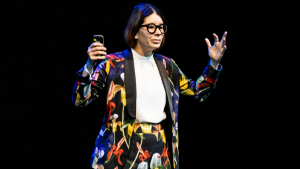
For Design Indaba’s 25th anniversary, Berlin-based artist, food designer and Global Graduate Alexandra Genis delivered a talk that brought speculative gastronomy to the forefront, using food as a provocative lens through which to examine sustainability, ecology and the future of human consumption. Presenting her project Atoma, Genis explored how synthetic flavour design and molecular gastronomy could reshape the way people think about food in a resource-constrained future. Her talk challenged audiences to confront their assumptions around “natural” food systems and the environmental cost of modern eating habits.
During her talk, Genis shared that the idea for Atoma emerged after noticing the contradiction on a yoghurt label claiming to contain “no artificial flavouring”. This prompted her to question whether recreating flavours synthetically might, in some cases, be more sustainable than transporting, cultivating and consuming resource-intensive ingredients. Through Atoma, a blend of the words “atom” and “aroma”, she developed a system that reconstructs flavours at a molecular level using 3D-printed flavour compounds infused into cocoa butter. These compounds can then be shaved or grated into food like spices, reproducing tastes such as strawberry without requiring the fruit itself.
Drawing on her background as the daughter of two chemists and a graduate of Design Academy Eindhoven’s Food Non Food department, Genis framed food as both a biochemical and cultural medium. Her studio, TAS2R, named after a bitter taste receptor, explores what she describes as “gastro-intestinal design fiction”, creating speculative culinary experiences that imagine food systems in post-climate crisis scenarios.
Throughout the talk, Genis positioned food design as a critical tool for discussing environmental collapse, consumer psychology and technological innovation. Her work interrogates humanity’s emotional attachment to authenticity and nature, while simultaneously proposing radical alternatives to industrial agriculture and global supply chains. Genis’s talk expanded the conversation around sustainable futures beyond architecture and technology into the realm of sensory experience and food culture.