Researchers at the University of Cambridge have developed Revoice, an AI-powered wearable device designed to help people regain the ability to communicate naturally following a stroke. The technology offers a non-invasive alternative for individuals experiencing speech impairment, restoring voice without the need for brain surgery.
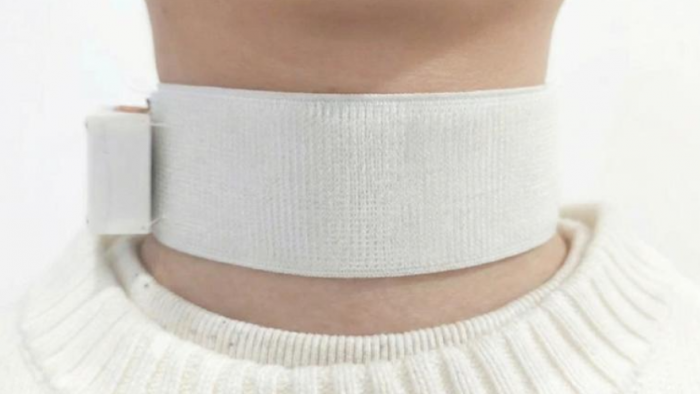
Designed as a soft, flexible woven fabric choker worn around the neck, Revoice is embedded with ultra-sensitive sensors that detect subtle physiological signals. Paired with AI, the device decodes speech signals and emotional cues, allowing users to communicate more fluidly and naturally.
Revoice captures the user’s heart rate and tiny vibrations from throat muscles, using these signals to reconstruct intended words and sentences in real time. The AI processes fragments of silently mouthed speech alongside emotional state and contextual information (such as time of day or environmental conditions), expanding brief phrases into complete, expressive sentences.
Compared with other assistive speech technologies that rely on letter-by-letter input, eye tracking or brain implants, Revoice enables seamless, real-time communication from mouthed words. In early trials involving five patients with dysarthria, a common post-stroke speech disorder, the device achieved a word error rate of 4.2% and a sentence error rate of just 2.9%.
Researchers are now planning a clinical study with native English-speaking dysarthria patients to further assess the system’s viability, which they hope to launch later this year. Beyond stroke rehabilitation, Revoice also shows potential for supporting people with neurological conditions such as Parkinson’s disease and motor neurone disease, a progressive and intuitive response to human-centred assistive design.