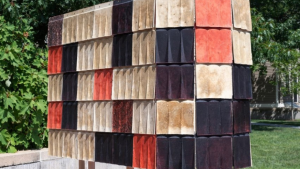
At Design Indaba’s 25th anniversary, renowned Ghanaian artist, Ibrahim Mahama presented his powerful body of work that redefines monumentality. Known for his large-scale installations, Mahama transforms buildings and public spaces using reclaimed materials, most notably jute sacks once used in Ghana’s cocoa trade.
Jute sacks, while seemingly ordinary, carries complex histories. Having travelled across borders and passed through countless hands, the sacks embody global systems of trade, labour and exchange. By stitching them together and draping them over architectural structures, Mahama creates works that are both visually striking and deeply political confronting the legacies of colonialism and capitalism.
Mahama’s conveys the idea that materials hold memory, sharing with audiences how the wear, stains and markings on each sack become a living archive of human activity, reflecting both the promises and failures embedded in Ghana’s post-independence history. Mahama provides insight into his installations, sharing that beyond the scale and spectacle, his work reveals the invisible systems that shape everyday life.
Mahama also emphasised the role of community in his practice. His works are often produced through collective labour and installed in public or socially significant spaces, inviting dialogue and participation. For him, art extends beyond objects it becomes a platform for rethinking institutions, histories, and futures.